


01 · quoting
The estimate gets rebuilt in Excel
Because the ERP cannot price a job the way you actually price it. The real logic lives in a workbook one person maintains.

// owner-led manufacturing & aerospace MRO · 25–150 employees
Your ERP handles part of the job. So does the spreadsheet, the quality system, the shared drive, the machine, and the employee who knows the workaround. We take ownership of the ugly part between them and make it work in production.
Senior engineers. Fixed outcomes. No army of junior consultants.
Michael reads it personally. If it fits, a short call leads to a fixed quote. No payment now.
100% US-based · no offshore subcontracting · ITAR / CMMC-aware
$ count open jobs --all-sources
reading erp export ............... ok
reading scheduling whiteboard .... photo, 7:12am
reading quoting workbook ......... v14_FINAL_rev3.xlsx
erp ............... 41
whiteboard ........ 47
workbook .......... 52
! 11 jobs exist in a spreadsheet only
! 6 jobs have no owner in any system
→ this is the number your month closes on
Your counts will differ. The disconnect will look familiar.
// recognize any of these
Every one of these is a workflow your ERP was supposed to cover. None of them are a software problem until you decide to fix them.
01 · quoting
Because the ERP cannot price a job the way you actually price it. The real logic lives in a workbook one person maintains.
02 · job status
Travelers move with the part. The system finds out at end of shift, end of week, or when a customer calls.
03 · quality
Certs, first-article results and NCRs sit in a shared drive, named by whoever scanned them. Traceability is a person, not a system.
04 · purchasing
You find out you are short when the line stops. Then somebody pays for expedited freight and nobody logs why.
05 · scheduling
The ERP schedule is a document nobody on the floor has trusted in years, so it stops getting corrected, so it gets worse.
06 · reporting
By the time you can see margin by job, the quarter is half over and the decisions have already been made.
None of this means your shop is run badly.
It means the work outgrew the system, and the gap got filled with people. That is the most expensive way to fill a gap.
// what we take on
01 · operational ai & integration
Production implementation across the systems you already run. A named workflow, a baseline, a measurable result, and a defined production handoff — whether the fix is integration, automation, or AI that finally has access to trustworthy operational data.
02 · system rescue & modernization
We take technical ownership of systems that have become business problems: the inherited application, the integration nobody understands anymore, the failing pipeline, the prototype that now has to run in production, the old system blocking everything behind it.
03 · managed operations
After launch, we operate what we implemented: monitoring, failure handling, AI-agent oversight, integration health, workflow updates, security patches, and operational reporting — continuously improved against a service level, not handed off and forgotten.
// how we work
We are not here to sell you a platform, replace your ERP, or start a two-year project. We start with the one gap that costs you the most and we close it.
Sometimes that is integration. Sometimes automation. Sometimes a small piece of software, or a report that finally tells the truth. The technology is the least interesting part of the decision.
step 01
You get a straight opinion on whether the workaround is worth fixing and whether we are the right people to do it. If the answer is "change a process, not the software," we say that.
step 02
If it is worth a short call, we define one outcome and give you a fixed quote before work begins. Your system of record stays in place; we work around it while your team keeps working.
step 03
You own your data, your infrastructure, your configuration, and your deployment artifacts. We retain the reusable platform core and license it to you; updates and managed operations run on a platform agreement. We build glass boxes: you should be able to see past the pretty numbers down to the exact queries that run your business.
// the finished work
A Washington, DC-area aerospace parts broker and MRO shop ran its operation across fifteen Monday boards holding roughly 14,000 line items, a 1.6 TB document store, QuickBooks, and a library of hand-built templates. Nobody could reliably answer a simple question: where is this part right now, and what condition is it in?
line items and a 1.6 TB archive consolidated into one system of record.
// industrial agriculture 500+API endpoints across sorting and grading lines, deployed and operated by us.
// heavy civil 5operating companies unified on one data model across every site.
Not the people. The seams: an order's history physically migrated from board to board as it aged — RFQ, to orders, to warehouse, to finance, to archive — stitched together only by free-text reference numbers typed by hand, with a 1.6 TB document archive that had no relationship to the jobs the documents belonged to.
Migrated roughly 14,000 records into one relational system of record with a single job identity from quote to delivery, digitized the MIL-STD-129 labeling and RFID workflows that were screenshots before, and instrumented storage with field gateways streaming temperature and humidity into real alerts.
One answer to "where is this part, and what condition is it in." Compliance labels print instead of being screenshotted. Corrosion-sensitive stock is monitored instead of hoped about. And traceability is a system, not a person.
project summary · aerospace MRO
rfq ............. ok
orders .......... ok
warehouse ....... ok
finance ......... ok
archive ......... ok
~ free-text reference numbers retired
✓ ~14,000 records, one job identity
✓ 1.6 TB of documents linked to their jobs
// the objections you are already thinking
Usually, yes — when the scope is a platform and the timeline is a year. That is why we scope one workflow, price it before we start, and tie it to a number you already track. If the fix cannot pay for itself, we tell you not to buy it.
→ Small, finished, paid-for pieces of work. Not a program.
Do not. We have never once recommended it as a first move. Your ERP stays the system of record; we fix the seams around it where the spreadsheets grew.
→ Old systems are our specialty, not our obstacle.
They do not have time for one, and a real fix should give time back rather than take it. We work from your existing data and short, scheduled conversations — not standing meetings and homework for your people.
→ Hours of your team's time, not weeks.
You keep everything you need to run without us: your data, your infrastructure, your configuration, the credentials, the documentation, and a plain-language runbook — in open formats a local hire or another firm can pick up.
→ The exit plan is part of the delivery, not a negotiation later.
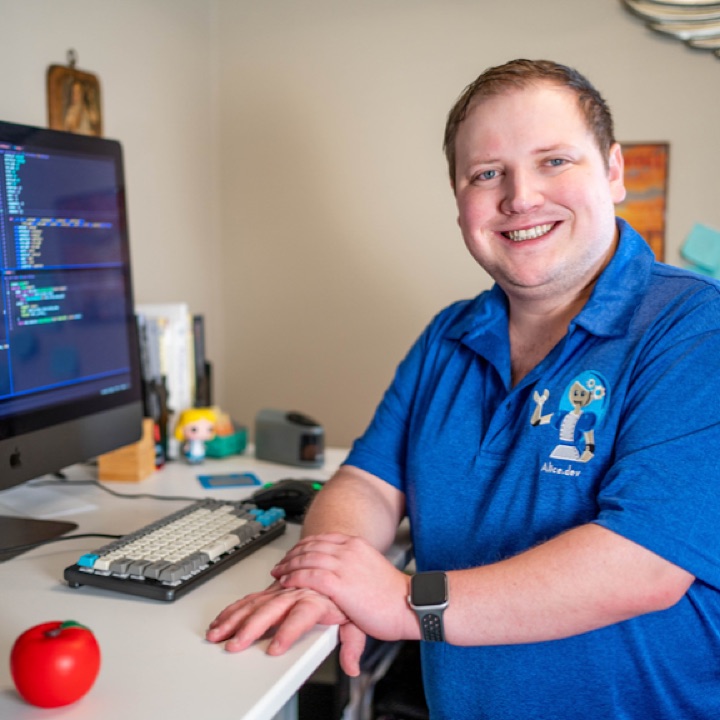
michael dominick · founder, the mad botter inc
// who you actually get
No account manager, no bench of juniors, no offshore handoff. You talk to Michael, and Michael stays on the work.
He has hosted Coder Radio since 2012 — 650+ episodes and 150,000+ monthly downloads as of 2026 — arguing in public about how software actually gets built. The same opinions you will hear on a call about your quoting workflow.
100% US-based. No offshore subcontracting.
Direct work for the US Navy and the US Air National Guard, and subcontract work supporting the US Army and US Air Force.
ITAR and CMMC-aware handling of controlled data from day one.
We are designed to support your compliance posture; we do not certify compliance.
// the podcast
// latest episode
// no deck, no discovery invoice
Describe the system everyone keeps working around, in your own words. Michael reads every one and replies personally with a straight opinion on whether it is worth fixing — and whether we are the right ones to fix it.
// what to bring
The name of the workflow that breaks most often.
Roughly how many people touch it, and how often.
What your ERP is, and how long you have had it.
That is enough for a useful reply. We do not need a requirements document, and we will not ask you to write one.
// michael reads every message and replies personally
// received
No sales sequence starts here. Michael reads what you sent and replies personally with a straight opinion: whether it is worth fixing, roughly what fixing it involves, and whether we are the right ones to do it.
reference
A confirmation email carrying this reference is on its way. No confirmation within a few minutes? Send that reference to [email protected] — the request is recorded on our side either way.